 With the continued growth of online businesses, ecommerce warehousing and fulfilment have become essential services for selling through platforms such as Shopify, Amazon and eBay. As customer expectations for fast, accurate deliveries continue to rise, many retailers are turning to specialist 3PL providers to manage their storage, order fulfilment and distribution.
Ecommerce fulfilment covers every stage of the order journey, from receiving stock into a warehouse and storing inventory to picking, packing and dispatching customer orders. Whether products arrive in pallets, cartons or shipping containers, a modern fulfilment warehouse ensures orders are processed efficiently and delivered to customers on time. This approach is particularly beneficial for direct-to-consumer (D2C) brands and growing ecommerce businesses looking to scale without investing in their own warehouse facilities.
Today’s fulfilment providers use advanced Warehouse Management Systems (WMS) that integrate directly with ecommerce platforms and online marketplaces, including Shopify, Amazon and eBay. These integrations automate key processes such as order processing, inventory management, shipping updates and tracking notifications, helping businesses improve accuracy, reduce manual administration, improve speed and provide a better customer experience.
This guide is designed for ecommerce retailers, online marketplace sellers, growing brands and businesses looking to outsource their fulfilment to a trusted UK or Ireland 3PL provider. It explains how ecommerce warehousing works, why warehouse integrations are so important, and how Shopify, Amazon and eBay connect with modern fulfilment operations. You’ll also learn about multichannel fulfilment, the role of WMS, and what to look for when choosing a fulfilment partner. Finally, we’ll show you how whichwarehouse can help you compare experienced fulfilment providers, request free quotes and find a warehousing solution that’s tailored to your business.
Why Integrations Matter
When ecommerce fulfilment first developed, many businesses relied on manual processes to manage orders, often using spreadsheets to communicate order details and update stock levels. While this approach may work for businesses handling smaller order volumes, it becomes increasingly difficult to manage as an ecommerce operation grows. More manual processes can lead to delays, stock inaccuracies and a greater risk of fulfilment errors.
Modern fulfilment warehouses now use advanced technology integrations to connect directly with online stores and marketplaces such as Shopify, Amazon, eBay and TikTok Shop. These integrations allow customer orders to flow automatically from the sales platform into the warehouse’s WMS, removing the need for businesses to manually send order information to their 3PL provider.
 Once an order is received, the warehouse team has access to the information. Inventory levels can be updated in real time across sales channels, helping prevent overselling and improving stock accuracy. After dispatch, tracking information is automatically returned to the ecommerce platform, allowing customers to receive delivery updates and businesses to manage enquiries more effectively.
For ecommerce businesses, these integrations create a more connected supply chain between the online store, warehouse and end customer. They enable retailers to process higher order volumes, improve operational efficiency and maintain a consistent customer experience across multiple sales channels.
Choosing the right fulfilment partner is therefore essential. Businesses should look for a 3PL provider that uses a reliable WMS and can integrate with their ecommerce platforms, whether they sell through Shopify, Amazon, eBay or other online marketplaces. whichwarehouse helps businesses compare fulfilment providers by gathering tailored quotes and identifying warehouses with the right systems, capabilities and experience to support their requirements.
What is eCommerce Warehousing?
 Ecommerce warehousing is the process of storing, managing, picking and distributing products for businesses that sell online. Unlike traditional warehousing, which often focuses on moving bulk stock between businesses, ecommerce fulfilment warehouses are designed around processing individual customer orders.
When an order is placed, the fulfilment warehouse receives the information through an integrated system, locates the required products, picks and packs the items, applies any required value-added services and arranges delivery to the end customer. This allows online retailers to outsource their logistics operations without needing to invest in their own warehouse facilities, staff or technology.
The main operations within an ecommerce warehouse cover the complete customer journey, from receiving stock through to final delivery.
Receiving & Storage
When products arrive at a fulfilment warehouse, stock is checked, recorded and stored in an organised location ready for future orders. Inventory is entered into the WMS, allowing the fulfilment provider and retailer to monitor stock levels, product locations and availability in real time.
Efficient storage processes are essential for ecommerce businesses managing large product ranges, seasonal demand or multiple sales channels.
Picking & Packing
When an order is placed through platforms such as Shopify, Amazon or eBay, the order information is automatically sent to the fulfilment warehouse. Using their WMS, warehouse operatives can identify the exact location of the products, pick the correct items and prepare them for dispatch.
 Many fulfilment centres also offer value-added services to support ecommerce brands, including:
- Bespoke packaging
- Branded inserts
- Product labelling
- Kitting and product assembly
- Promotional packaging
These services help businesses create a stronger customer experience while keeping fulfilment operations efficient.
Shipping & Delivery
Once an order has been picked and packed, it is prepared for delivery to the customer. Depending on the fulfilment provider, this may be completed through the warehouse’s own transport operation or through integrated courier networks.
Tracking information is updated after dispatch and sent back to the ecommerce platform, allowing businesses to monitor deliveries and respond to customer enquiries.
Returns Management
Returns management is an important part of ecommerce fulfilment, particularly in industries such as fashion and retail where customers may return products due to sizing, preferences or product requirements.
A 3PL fulfilment provider can manage the complete returns process, including:
- Receiving returned items
- Inspecting product condition
- Updating inventory records
- Repackaging products
- Returning stock to saleable inventory
Effective returns management helps businesses maintain accurate stock levels while providing customers with a smooth returns experience.
Inventory Management
 Accurate inventory management is essential for ecommerce businesses selling across multiple channels. A reliable fulfilment warehouse provides real-time stock visibility, helping businesses prevent overselling, improve replenishment decisions and maintain accurate availability across platforms.
By outsourcing ecommerce warehousing to a specialist 3PL fulfilment partner, businesses can focus on growing their brand while experienced logistics professionals manage storage, fulfilment and distribution.
Process of eCommerce Fulfilment
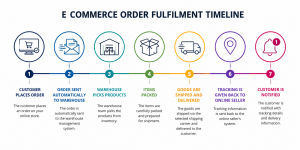
Information Passed Between eCommerce Platform & Fulfilment Centre
The ecommerce fulfilment process begins when a customer places an order and continues through to picking, packing and shipping the goods for delivery. Throughout this journey, a WMS keeps the retailer, fulfilment warehouse and customer updated by sharing important order and inventory information.
When an order is placed through an integrated ecommerce platform, the order details are automatically transferred to the fulfilment warehouse. This removes the need for businesses to manually send order information and allows the warehouse team to begin processing orders quickly and accurately.
 The information passed to the warehouse typically includes:
- Customer details – Name, delivery address, contact information and any specific delivery instructions required to complete the order.
- Order information – Order number, date and time of purchase, products ordered, quantities and SKU details to ensure the correct items are picked.
- Product information – Details such as product variations, including size, colour or model, where applicable.
- Shipping information – The selected delivery service, shipping method and required delivery timeframe.
- Inventory updates – Stock movements are recorded within the WMS, keeping inventory levels accurate across ecommerce channels. This is particularly important when managing multiple sales platforms and customer returns.
After the order has been dispatched, tracking information and order status updates are sent back through the integration. This allows businesses to monitor deliveries, keep customers informed and manage any queries effectively.
The connection between an ecommerce platform and fulfilment warehouse creates a more efficient and transparent order journey. Accurate data transfer reduces manual administration, minimises fulfilment errors and allows businesses to scale their operations across multiple sales channels while maintaining a consistent customer experience.
Common Industries Requiring Ecommerce Fulfilment
 Ecommerce fulfilment is used across a wide range of industries, from emerging online retailers to established brands processing thousands of orders each month. The right 3PL provider can help businesses manage inventory, improve delivery performance and scale their operations efficiently.
- Fashion Industry – Fashion retailers often require flexible fulfilment solutions due to seasonal demand, large product ranges and high return volumes. Fulfilment warehouses help manage clothing storage, size variations, order processing and returns. A reliable WMS is particularly important within fashion fulfilment due to the number of SKUs, product variations and frequent inventory changes.
- Electronics – Electronic products are increasingly purchased online, creating demand for secure storage, accurate inventory control and careful handling. Many electronics businesses manage multiple product variations, accessories and components, which can add complexity to fulfilment operations. Experienced fulfilment providers help manage these requirements through organised storage, barcode scanning and reliable warehouse processes.
- Food and Drink – Food and beverage businesses often require specialist fulfilment solutions, including stock rotation, batch tracking and temperature-controlled storage where required. Fulfilment providers with experience in food logistics can help businesses maintain compliance while ensuring products are stored and dispatched correctly.
- Subscription Models – Subscription businesses rely on consistent picking, packing and dispatch processes to deliver recurring orders efficiently. Fulfilment providers can support subscription brands through kitting services, bespoke packaging, scheduled fulfilment and recurring order management.
Ecommerce Fulfilment & Pallet Storage Pricing
Ecommerce fulfilment and pallet storage prices vary between providers depending on factors. To understand the costs involved, the factors that influence pricing and how businesses can reduce fulfilment expenses, see our guides on UK fulfilment services pricing and pallet storage costs.
Common Integrations
Common ecommerce integrations include:
 Shopify – One of the most popular ecommerce platforms, allowing businesses to connect their online store with a fulfilment warehouse for automated order processing, inventory updates and shipping information.
- WooCommerce – A flexible ecommerce platform built on WordPress that integrates with fulfilment providers to manage orders, stock and deliveries.
- Amazon – Fulfilment integrations connect with Amazon Seller Central to manage orders, inventory and shipping updates, including businesses using Amazon FBM.
- eBay – Allows sellers to automate order processing, stock updates and tracking information between eBay and their fulfilment provider.
- TikTok Shop – Enables businesses selling through social commerce to connect customer orders directly with fulfilment warehouses.
- Facebook & Instagram Shops – Allows brands to manage social commerce orders alongside other ecommerce channels.
- ERP systems – Connect business management software with warehouse operations for improved visibility across sales, inventory and finance.
- Courier integrations – Connect fulfilment warehouses with shipping providers to automate label creation, tracking and delivery updates.
- API integrations – Custom connections that allow businesses to link their own systems with a WMS.
Shopify Warehousing
Shopify is one of the world’s leading cloud-based ecommerce platforms, enabling businesses to create, manage and grow their own online stores without needing extensive technical knowledge. Unlike online marketplaces, Shopify allows retailers to build a branded ecommerce website while managing products, payments, inventory, customer orders and reporting from a single platform.
One of Shopify’s biggest strengths is its flexibility. Through the Shopify App Store, businesses can extend the platform with thousands of applications, including accounting software, marketing tools, customer support solutions and warehouse management integrations. This makes Shopify a popular choice for businesses of all sizes, from start-ups launching their first online store to established retailers selling thousands of products each day.
Many UK ecommerce businesses choose Shopify because it is straightforward to set up, offers secure online payments, provides a responsive shopping experience across desktop and mobile devices, and supports multichannel selling. Retailers can manage sales through their Shopify website while also connecting with marketplaces such as Amazon and eBay, as well as social commerce platforms like TikTok Shop and Facebook.
 As order volumes increase, many Shopify businesses choose to outsource their logistics to a specialist 3PL provider. A Shopify fulfilment warehouse stores inventory, processes customer orders, manages returns and keeps stock levels up to date, allowing retailers to focus on growing their business rather than managing day-to-day warehouse operations.
When a customer places an order through a Shopify store, the platform automatically transfers the order to the fulfilment warehouse using Shopify’s API. The warehouse’s WMS receives the order information, identifies the storage location of each product, generates picking instructions and guides warehouse staff through the picking and packing process. Once the order has been dispatched, tracking information and fulfilment updates are automatically sent back to Shopify, allowing both the retailer and customer to monitor delivery progress.
The information exchanged between Shopify and a fulfilment warehouse typically includes the order number, customer details, delivery address, products ordered, SKUs, quantities, shipping method and any delivery notes. As the order progresses, the warehouse returns fulfilment status updates, tracking numbers and inventory changes, ensuring stock levels remain accurate across the business.
For growing ecommerce businesses, integrating Shopify with a fulfilment warehouse provides significant operational benefits. Automated order processing reduces manual administration, real-time inventory synchronisation helps prevent overselling, and faster order fulfilment improves the customer experience. By outsourcing warehousing to an experienced 3PL provider, Shopify merchants can scale their operations with confidence while maintaining efficient and reliable fulfilment.
whichwarehouse helps businesses compare Shopify-compatible fulfilment companies across the UK and Ireland, making it easier to find providers with the right warehouse management systems, ecommerce integrations, locations and fulfilment services to support long-term growth.
Amazon Fulfilment
Amazon is one of the world’s largest ecommerce marketplaces, giving businesses access to millions of customers across the UK and internationally. Unlike Shopify, where retailers build and manage their own online store, Amazon provides a marketplace where products are listed alongside other sellers and discovered through Amazon’s search results, recommendations and Prime delivery network.
For many ecommerce businesses, Amazon becomes a significant sales channel as order volumes increase. As a result, sellers need an efficient way to store inventory, process customer orders and deliver products quickly while maintaining high performance standards.
Amazon offers two primary fulfilment models: Fulfilment by Amazon (FBA) and Fulfilment by Merchant (FBM). Choosing the right option depends on a business’s fulfilment strategy, stock levels and whether they also sell through other ecommerce platforms.
Amazon FBA (Fulfilment by Amazon)
With Amazon FBA, sellers send their inventory to an Amazon fulfilment centre, where Amazon stores the products, picks and packs customer orders, dispatches deliveries and manages much of the customer service and returns process.
For businesses that want to focus on product development, marketing and sales rather than day-to-day logistics, Amazon FBA can be an attractive solution. Products fulfilled through FBA are also generally eligible for Amazon Prime, helping businesses meet customer expectations for fast, reliable delivery while increasing product visibility on the marketplace.
 Many ecommerce businesses, however, choose to use a 3PL provider alongside Amazon FBA. Instead of sending all of their inventory directly to Amazon, they store additional stock with an independent fulfilment warehouse. The 3PL can then replenish Amazon fulfilment centres as stock levels fall, prepare inventory to Amazon’s requirements, apply value-added services such as labelling and kitting, and manage storage more efficiently.
Using a 3PL alongside FBA also gives businesses greater flexibility to sell through other sales channels, including Shopify, eBay and TikTok Shop, without relying solely on Amazon’s fulfilment network.
Amazon FBM (Fulfilment by Merchant)
With Amazon FBM, the seller remains responsible for storing inventory and fulfilling customer orders. Rather than managing these operations in-house, many businesses partner with a specialist Amazon FBM fulfilment warehouse that integrates directly with Amazon Seller Central.
When a customer places an order on Amazon, the order information is automatically transferred to the warehouse’s WMS. Warehouse operatives then locate the products, pick and pack the order, arrange shipment and dispatch it to the customer. Once the order has been shipped, tracking information and fulfilment updates are automatically returned to Amazon.
Amazon FBM allows businesses to benefit from Amazon’s global marketplace while maintaining greater control over their inventory, warehousing and fulfilment operations. It is particularly popular with retailers selling across multiple platforms, as inventory can be stored in a single warehouse and used to fulfil orders from Amazon, Shopify, eBay and other ecommerce channels. This eliminates the need to split stock across multiple fulfilment networks and provides greater flexibility as the business grows.
Amazon Warehouse Integrations
Modern fulfilment providers can integrate directly with Amazon Seller Central, creating an automated connection between the marketplace and the warehouse’s Warehouse Management System.
These integrations allow important information to flow seamlessly between both systems, including:
- Order numbers and customer details
- Products, quantities and SKUs
- Shipping methods and delivery requirements
- Dispatch confirmations
- Tracking numbers
- Inventory updates
- Order status changes
By automating the exchange of data, Amazon warehouse integrations reduce manual administration, improve inventory accuracy and help businesses process larger order volumes more efficiently.
Many growing ecommerce businesses adopt a hybrid fulfilment strategy, storing inventory with a specialist 3PL while using a combination of Amazon FBA and Amazon FBM. This approach provides the flexibility to meet Amazon’s fulfilment requirements while supporting multichannel sales through Shopify, eBay, TikTok Shop and other ecommerce platforms.
Whether you’re looking for an Amazon FBM warehouse or a 3PL to support your Amazon FBA operations, whichwarehouse helps businesses compare experienced fulfilment providers across the UK and Ireland. By comparing warehouse locations, ecommerce integrations, fulfilment services and WMS, businesses can find a fulfilment partner that supports both their current operations and future growth.
eBay Warehousing
Another of the world’s largest online marketplaces, eBay enables both businesses and individuals to sell products to customers across the UK and internationally. While it first became known for online auctions, eBay has evolved into a leading ecommerce platform where businesses can create professional stores, offer fixed-price listings and reach millions of potential buyers.
 For many retailers, eBay forms part of a wider multichannel sales strategy alongside platforms such as Shopify, Amazon and TikTok Shop. Selling across multiple channels helps businesses reach a broader audience, but it also creates additional challenges when managing inventory, processing orders and keeping stock levels accurate across every platform.
Unlike Amazon, eBay does not operate its own fulfilment network. Sellers remain responsible for storing inventory, processing customer orders and arranging delivery. As order volumes increase, many businesses choose to outsource these operations to a specialist third-party logistics provider, allowing them to manage fulfilment more efficiently while supporting sales across multiple ecommerce channels. The process follows the same as others when an order is received it goes straight to the warehouse to be refilled.
Modern fulfilment providers integrate directly with eBay using APIs and WMS, creating a seamless connection between the online marketplace and warehouse operations. These integrations automate order processing, synchronise inventory in real time and return tracking information automatically, helping businesses reduce manual administration, minimise fulfilment errors and deliver a consistent customer experience.
Omnichannel Fulfilment
As ecommerce businesses grow, many expand beyond a single sales channel to reach more customers. Rather than selling exclusively through Amazon, for example, retailers often list their products on Shopify, eBay, TikTok Shop, Facebook and other ecommerce platforms to increase brand visibility and maximise sales opportunities.
While selling across multiple channels can accelerate business growth, it also adds complexity to day-to-day operations. Orders can arrive from several platforms at the same time, inventory must remain accurate across every sales channel, and customers expect fast, reliable delivery regardless of where they place their order. Without the right systems in place, managing stock manually can quickly become time-consuming and increase the risk of fulfilment errors.
 This is where omnichannel fulfilment becomes essential. By partnering with a 3PL provider that supports multichannel fulfilment, businesses can store all their inventory in one central warehouse while connecting multiple ecommerce platforms through a WMS. As orders are placed, inventory levels are automatically updated across every connected sales channel, reducing manual administration and helping to prevent overselling.
Businesses using omnichannel fulfilment can benefit from:
- Selling across multiple marketplaces using a single fulfilment partner.
- Real-time inventory synchronisation across every sales channel.
- Faster and more accurate order processing.
- Reduced manual administration through automated integrations.
- Improved stock visibility and replenishment planning.
- Greater scalability during seasonal peaks and business growth.
- A consistent customer experience regardless of where an order is placed.
By centralising inventory and fulfilment with a specialist 3PL provider, ecommerce businesses gain greater operational efficiency while retaining the flexibility to expand into new marketplaces as they grow. However, the success of an omnichannel fulfilment strategy depends on the warehouse’s WMS. Choosing a fulfilment partner with a modern, well-integrated WMS ensures your business can connect with the ecommerce platforms you use today while supporting future expansion as your sales channels evolve.
Warehouse Management Systems (WMS)
A warehouse management system (WMS) is the software that controls day-to-day warehouse and fulfilment operations. It helps fulfilment providers manage inventory, process orders, track stock movements and coordinate picking, packing and shipping activities from one central system.
 In ecommerce fulfilment, the WMS acts as the connection between the online store and the warehouse. When a customer places an order through platforms such as Shopify, Amazon or eBay, the order is automatically received by the WMS, which then guides warehouse staff through the fulfilment process and updates the sales channel once the order has been dispatched.
Modern WMS platforms also support barcode scanning, real-time inventory visibility, courier integrations and reporting tools. These features help fulfilment warehouses improve accuracy and scale efficiently as order volumes grow.
When choosing a fulfilment partner, it is worth checking which Warehouse Management System they use and whether it integrates with your ecommerce platforms, marketplaces and business systems. A reliable WMS is often the foundation of an efficient ecommerce fulfilment operation.
Choosing an eCommerce Fulfilment Partner
Not every warehouse is the same, each one offers something different which is why choosing the right fulfilment partner is important. Every ecommerce business has different requirements depending on the products they sell, order volumes, sales channels and customer expectations. Before selecting a fulfilment partner, it is important to understand not only the services they offer, but also the technology, experience and scalability they can provide.
 Ensuring that the warehouse’s WMS is compatible with the sales platforms the business works with is very important as each WMS is also unique. One may work with Shopify and Amazon while another may only be compatible with eBay. Businesses should also ensure that additional marketplaces can be added at a later date in case of global expansion for example.
When comparing ecommerce fulfilment providers, consider whether they offer:
- Shopify, Amazon and eBay integrations.
- A modern warehouse management system.
- Real-time inventory management and reporting.
- Pick and pack services.
- Returns management.
- Same-day or next-day dispatch.
- Courier integrations with multiple delivery providers.
- Value-added services, such as kitting, labelling and bespoke packaging.
- Multichannel fulfilment capabilities.
- International shipping and customs support where required.
- Scalable, flexible warehouse space that can grow with your business.
It is also worth asking how the warehouse manages seasonal demand, whether they have experience within your industry and what reporting tools are available to help monitor stock levels and fulfilment performance. Choosing a fulfilment provider with proven ecommerce experience can help reduce operational challenges while giving your business the flexibility to scale.
Compare eCommerce Warehousing & Fulfilment Providers
 Whether you are an eCommerce start up or an established business looking to switch fulfilment providers, choosing the right warehouse makes all the difference. From selling solely on Shopify to running an omnichannel sales strategy, 3PLs make your operations more efficient and reliable while you focus on growing your business in other areas. Every warehouse offers something different whether that be services, technology, expertise or location. Taking the time to compare providers ensures you find a warehouse that matches both your current requirements and your future growth plans.
whichwarehouse makes it simple to compare trusted ecommerce fulfilment providers across the UK and Ireland.
Instead of contacting multiple warehouses individually, complete our Get Free Quotes form with details about your storage and fulfilment requirements. We’ll connect you with suitable providers, allowing you to compare warehouse locations, fulfilment services, WMS capabilities, ecommerce integrations, industry experience and pricing before deciding which companies to speak with.
By comparing multiple providers in one place, businesses can save valuable time while finding a fulfilment partner that best matches their products, order volumes and long-term growth plans.
Find Ecommerce Fulfilment Warehouses Near You
Looking for a fulfilment warehouse in a specific location? whichwarehouse allows you to search for ecommerce fulfilment providers across the UK and Ireland, making it easy to compare local warehouses based on their location.
If you need a warehouse close to your suppliers, customers or transport network, comparing local fulfilment providers can help reduce delivery times, improve operational efficiency and support future growth.
Compare Shopify, Amazon & eBay Fulfilment Companies
whichwarehouse helps you find fulfilment providers with the right technology including Shopify, Amazon, eBay or multiple ecommerce platforms.
Submit your requirements today to receive free, no-obligation quotes from experienced 3PL providers across England, Scotland, Wales and Ireland, compare your options and find a fulfilment partner that can grow alongside your business.