- Storage
- Fulfilment
- Transport
- Dropshipping
Compare fulfilment centres with the UK’s largest warehousing site. Access 3500+ 3PL providers and get free quotes to save on costs and time.
 Fulfilment services have become a core part of modern logistics operations in the UK, supporting businesses that need efficient storage, order processing and distribution. Offered by warehouses and third-party logistics providers (3PLs), fulfilment covers the complete order journey, from receiving and storing stock through to picking, packing, value-added services and final despatch.
Businesses of all sizes, from growing ecommerce retailers to established national brands, outsource fulfilment for greater operational efficiency and scalability. As order volumes increase, managing inventory, staffing and dispatch in-house can become resource intensive. Working with a 3PL allows companies to streamline operations, improve accuracy and access established warehousing infrastructure without the fixed costs of running their own facility.
How Fulfilment Works
The fulfilment process has multiple stages that work together to ensure accuracy, speed and cost efficiency. It begins with goods in, where stock is delivered to the warehouse. Products are checked against purchase orders, inspected for damage and logged into the warehouse management system before being allocated a storage location. Accuracy at this stage is critical, as errors can affect stock levels and future order fulfilment.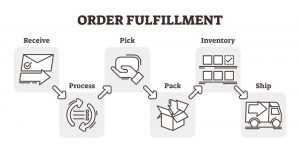
Once received, goods are stored based on factors such as size and weight, handling requirements, specialist storage needs and turnover rate. Fast-moving products are typically positioned closer to picking locations to reduce travel time and improve efficiency, rather than being stored in less accessible areas of the warehouse.
The next stage begins when an order is received. For ecommerce businesses this may come from their own website or from marketplaces such as Amazon, eBay or Shopify. Through system integrations, the order is transmitted directly to the 3PL so processing can begin immediately.
Warehouse operatives then retrieve the required items using scanners and digital picking systems. Depending on the operation, this may involve single order picking, batch picking or zone picking. Accuracy here is essential, as incorrect or missing items directly impact customer satisfaction. Once picked, items are checked, packed into appropriate packaging and labelled for shipment. This is also where value added services may take place, including branded packaging, kitting, assembly or promotional inserts.
Orders are then handed over to a courier or distribution network for despatch. Some 3PLs operate regionally, nationally or internationally, while others partner with established carriers. Tracking information is typically passed on to the end customer.
If goods are returned or an issue arises, 3PLs manage the reverse logistics process. This includes inspection, processing, restocking and, where necessary, disposal. Efficient returns management has become an increasingly important part of modern fulfilment operations.
Types of Fulfilment Services
Order Fulfilment
Order fulfilment is the overarching process of completing customer orders from start to finish. It covers receiving, storing, picking, packing, despatching and handling returns. Businesses of all sizes rely on order fulfilment services to ensure customers receive accurate and timely deliveries. Depending on circumstances, different types of order fulfilment may be used to meet specific business needs.
eCommerce Fulfilment
 Ecommerce fulfilment is ideal for direct-to-consumer (D2C) brands. Orders from online shops are transmitted to the warehouse for fulfilment. Ecommerce fulfilment integrates with platforms such as Amazon, Shopify and eBay. These operations often involve high volumes of smaller orders that require fast processing due to rising demand for same-day or next-day delivery. Value-added services such as branded packaging and returns handling are essential. The key to successful ecommerce fulfilment is speed, accuracy, scalability during peak periods and cost efficiency, all of which impact customer satisfaction.
Omnichannel Fulfilment
Omnichannel fulfilment is similar to ecommerce fulfilment but involves selling across multiple channels simultaneously. This can include a business’s own website alongside marketplaces like Amazon, Shopify and eBay, and may serve both consumers and other businesses. To manage omnichannel fulfilment effectively, 3PLs must have robust warehouse and inventory management systems to monitor stock levels, prevent overselling and fulfil orders accurately across all channels.
B2B Fulfilment
Business-to-business (B2B) fulfilment typically involves larger order quantities than ecommerce, often shipped on pallets to retailers, wholesalers or distributors. Orders are usually scheduled in advance through booking slots rather than placed online. B2B fulfilment often relies on freight distribution using HGVs, and many clients, such as supermarkets, require compliance labelling and strict adherence to retailer standards. Accuracy, efficiency and reliability are critical in this type of fulfilment.
Subscription Fulfilment
Subscription fulfilment deals with recurring orders, such as membership boxes or monthly product shipments. Warehouses can predict demand based on subscriptions and cancellations, allowing them to plan inventory and labour effectively. These orders are often processed in batches, and value-added services such as kitting, assembly and branded packaging are frequently required to create a polished customer experience.
Specialist Fulfilment
Specialist fulfilment covers operations that require particular storage or handling capabilities. This could include temperature-controlled goods, hazardous materials, fragile items or high-value products. Some 3PLs specialise in specific industries, such as fashion, where returns management is critical, or food, where labelling, compliance and shelf-life management are essential.
Value-Added Services
Value-added services (VAS) are not a standalone fulfilment type but an extra layer of support that enhances standard fulfilment. These can include kitting, assembly, labelling, repackaging, branding materials and quality checks. VAS adds both functionality and branding value to orders.
The right type of fulfilment depends on sales channels, product type, order volume and business growth plans. Choosing the appropriate fulfilment model ensures efficiency, scalability and customer satisfaction as your operation grows.
Fulfilment Models
Businesses can manage their fulfilment operations through a variety of methods, depending on order volumes, product types, and growth plans. The main models include:
In-House Fulfilment
 In-house fulfilment involves managing all aspects of order processing internally, from receiving stock and storage to picking, packing, despatch and returns. This model gives businesses complete control over operations and processes, ensuring standards are maintained exactly as desired. It works well for small businesses with low order volumes or specialised products. However, as the business grows, in-house fulfilment often becomes resource-intensive. Scaling requires additional warehouse space, labour, technology and management, which can be costly and time-consuming.
Outsourced Fulfilment
Outsourcing fulfilment to a 3PL allows businesses to leverage the experience, infrastructure and technology of specialist providers. Outsourced fulfilment offers flexibility to scale operations quickly during peak periods or rapid growth, without the overheads of recruiting staff or expanding facilities. 3PLs often provide integrated inventory management, carrier networks, and value-added services, helping businesses improve accuracy, speed and customer experience. Outsourcing also enables businesses to focus on core activities such as product development, marketing and customer service rather than warehouse management.
 Hybrid Fulfilment
Some businesses choose to keep certain aspects of fulfilment in-house, such as storing high-value goods, while outsourcing other services like pick and pack or value-added operations. This approach offers more control over critical processes while still benefiting from external expertise, although it introduces additional operational complexity.
Dropshipping
In dropshipping, the supplier holds inventory and ships directly to the customer. This model reduces warehousing and operational burden for the business, but it sacrifices control over stock, quality checks, branding and delivery speed. Dropshipping is often used by smaller ecommerce businesses or when testing new products.
Distributed Fulfilment
Distributed fulfilment involves holding stock across multiple locations or local networks. This model benefits businesses aiming to deliver nationwide quickly, reducing shipping costs and improving delivery times. However, it adds complexity and requires an exceptional inventory management system to maintain accurate stock visibility.
Why Outsource Fulfilment?
 Outsourcing fulfilment offers several key benefits. It allows businesses to scale operations efficiently, streamline processes, and reduce costs, all while focusing on growth areas. Outsourcing also provides a hassle-free alternative to managing an in-house warehouse or 3PL operation.
Some common triggers for outsourcing include:
- Slow delivery times impacting customer satisfaction
- Limited storage space restricting growth
- Pick and pack processes becoming too slow or inefficient
- Inventory management becoming difficult to track
Many businesses start small and manage storage and fulfilment internally. However, as orders increase and stockholding requirements grow, space shortages and additional staffing needs often create challenges. Outsourcing to a trusted 3PL provides flexibility, cost-efficiency, and support tailored to the level of assistance your business requires, whether that’s handling all orders or just specific aspects of the fulfilment process.
Fulfilment Pricing
There is no fixed price for fulfilment services. Costs vary between 3PL providers depending on the services required, order volume, product type and operational complexity. Pricing is built around how your fulfilment operation runs day to day.
Storage
 Storage is typically charged per pallet per week, per sq ft (total cost per month), per carton or per SKU, depending on how stock is stored. In the UK, pallet storage commonly ranges between £1.50 and £5.00 per pallet per week, although location, warehouse type (ambient, chilled or specialist) and stock turnover will influence this. High-demand warehouse locations closer to major transport routes often command higher rates. For more information check out our in-depth pallet storage guide.
Pick and Pack
Pick and pack is usually charged per order, per order line or per item picked. Higher volumes can reduce the cost per order, while complex orders with multiple SKUs may increase handling time and cost. Rates vary significantly depending on order profile, product size and picking method as well as the efficiency of the technology being used. These range from 38p to £3.80 per order.
Despatch & Distribution
Distribution costs depend on delivery speed, parcel size and weight, carrier rates and fuel costs. Same-day and next-day services typically cost more than standard delivery. Businesses shipping nationwide or internationally may benefit from a 3PL’s pre-negotiated carrier rates, which can offer economies of scale compared to arranging shipping independently. An order depending on size and premium delivery services range from 89p to £12.00. 89p is average for posts and these prices range from small envelopes to 25kg packages. Pallet distribution depending on weight and volume is from £42 to £140 per pallet.
Value Added Services
Additional services such as kitting, assembly, labelling, repackaging, quality checks and branded packaging are usually priced separately. Costs vary depending on complexity and volume. While these services increase unit cost, they can improve customer experience and brand perception. Simple labelling or inserts range from 5p to 50p per unit, kitting or assembly: 50p to £3.00+ per unit, depending on complexity, each service is different and ranges from 5p to £10.00. Value added services can be charged based on hourly rates or key performance indicators (KPIs) such as labelling numbers. Returns processing is often charged between 30p and £6.00 per return, depending on inspection requirements and additional services.
Warehouse Management Systems (WMS)
Many 3PLs include access to their warehouse management systems as part of their service, while others may charge separately depending on integration requirements. A strong WMS provides inventory visibility, order tracking and reporting, which is essential for ecommerce and omnichannel operations. Where charged, integration or platform fees depend on system complexity and required integrations. Usually, these charges are built into other costs or if it is dedicated to one business or used in a shared environment.
What Impacts Fulfilment Costs?
Order volume and stock levels are key pricing drivers. Higher order volumes can reduce per-order costs, but low volumes may attract minimum monthly charges. The number of SKUs also affects pricing, as larger product ranges often require more complex picking and inventory management.
Seasonal peaks may increase labour and space requirements, impacting costs during busy periods. Products that require specialist storage, such as temperature-controlled, hazardous or high-value goods, typically incur higher handling fees. Premium delivery expectations, particularly next-day or same-day despatch, will also raise overall fulfilment costs.
Warehouse location plays a major role. Facilities closer to major transport hubs and population centres may charge higher storage rates but reduce last-mile delivery costs and transit times.
How to Keep Fulfilment Costs Under Control
Planning ahead for peak periods allows 3PLs to allocate labour and space efficiently, often helping to avoid last-minute surcharges. Choosing the correct fulfilment model, whether outsourced, hybrid or in-house, ensures your operation matches your growth stage.
Maintaining organised inventory, clear SKU labelling and predictable order patterns can significantly reduce picking time and labour costs. Most importantly, selecting a 3PL that supports long-term scalability prevents costly transitions as your business expands.
Comparing multiple fulfilment providers helps you understand the market and find the right balance between price, service capability and location. Cost should be considered alongside reliability, technology and growth potential.
Common Fulfilment Mistakes To Avoid
- Choosing solely on price without considering location, services available and the 3PL’s WMS.

- Failing to plan for rapid growth or seasonal peaks, which can lead to delays, stock issues and unexpected costs.
- Not checking whether the 3PL’s WMS aligns with your operational requirements, reporting needs and ecommerce integrations.
- Overlooking contract terms, including minimum volumes, notice periods and potential hidden fees.
- Ignoring returns management, particularly for ecommerce businesses where reverse logistics plays a critical role in customer satisfaction.
- Lack of system integration between your omnichannel sales platforms and the 3PL’s WMS, increasing the risk of errors and manual processing delays.
- Choosing a provider that cannot scale with your growth, potentially leading to operational disruption and costly transitions later.
- Poor communication and limited reporting, making it difficult to maintain visibility and control over fulfilment performance.
How whichwarehouse Can Help
For more information on how whichwarehouse helps businesses compare fulfilment providers, request free quotes and find suitable 3PL partners across the UK, visit our Find Fulfilment Services page.
If you are a warehouse or 3PL looking to advertise your fulfilment services and connect with active enquiries, visit our Fill Space page to learn how we can help promote your available capacity.
Fulfilment Services in the UK: FAQs
What are fulfilment services?
Fulfilment services cover the complete process of handling customer orders, from receiving and storing stock to picking, packing, despatch and managing returns. Provided by warehouses and third-party logistics (3PL) companies, fulfilment enables businesses to outsource operational tasks while improving efficiency, scalability and delivery performance.
Should I outsource fulfilment or keep it in-house?
In-house fulfilment offers control but requires warehouse space, labour and technology investment. Outsourcing to a 3PL provides scalability, infrastructure and operational expertise without fixed overheads. Many growing businesses choose outsourced fulfilment to manage increasing order volumes and seasonal peaks more efficiently.
What types of businesses use fulfilment services?
Fulfilment services are used by ecommerce retailers, subscription box companies, wholesalers, manufacturers and national brands. Businesses experiencing growth, limited storage space or increasing operational complexity often outsource fulfilment to improve efficiency and customer service.
What is ecommerce fulfilment?
Ecommerce fulfilment is designed for online retailers selling directly to consumers. Orders placed through websites or marketplaces such as Amazon or Shopify are automatically transmitted to a 3PL for picking, packing and despatch. Speed, accuracy and integration with ecommerce platforms are essential for successful ecommerce fulfilment.
What is a warehouse management system (WMS)?
A warehouse management system (WMS) is software used by 3PLs to track inventory, manage orders and monitor warehouse activity in real time. A strong WMS provides stock visibility, reporting and system integrations, helping businesses prevent overselling and maintain fulfilment accuracy.
What factors affect fulfilment pricing?
Pricing is influenced by order volume, number of SKUs, storage type, delivery speed, product handling requirements and warehouse location. Seasonal demand and specialist storage needs can also increase costs. Comparing multiple providers helps businesses understand pricing structures and service levels.
How do I find a fulfilment services in the UK?
Businesses can search for fulfilment by location and service requirements. Using whichwarehouse allows you to compare multiple providers, request free quotes and shortlist suitable options based on your operational needs.